It’s a tiled floor mosaic but I saw it this week lifted onto the wall of the Ashmolean museum in Oxford, and it was beautiful and affecting. The Romans thought about life differently. They knew death was waiting, that it’s present even in the happiest of times, even in the midst of the feast. That’s not depressing, it’s simply the truth, neither good nor bad.
Death carries the wine jugs to remind us it’s not time yet. We can still eat. We can still drink, We can love and laugh. Luckily for us, there’s still time. But not enough to waste.
If you click here you will be linked through to my column for Traveller24 on how I have offered myself as a human sacrifice to the rugby World Cup this year. But as a public service to any sport-loving South African in Athens, I offer you these pictures of the best rugby-watching pub in the world:
The James Joyce on Astiggos Street in Monastiraki, just past the Museum of Illusions, right next to the ancient agora of Athens. On a rugby day, it’s welcoming, accommodating and inclusive –
Although it’s recommended you come early for the best seat at the bar, with plenty of elbow room for eating Bar-B-Q chicken wings.
I have no idea whether you’ll be interested in this letter or not, but I’ve been giving much thought to the lost art of letter writing lately, and it occurs to me that even the most prolific letter writers sometimes really just banged on about what interested them.
I’m reading a selection of Patrick Leigh Fermor’s letters at the moment, and he is very funny and gossipy and affectionate and all of that, but sometimes he just yatters on for pages on end about the inscriptions on a church in some remote village of the Mani, or whether or not some moth-eaten local fisherman might plausibly be descended from Constantine XI Paleologos, the last Byzantine emperor who fell defending the walls of Constantinople against Mehmet’s Turks in 1453, or whatever. Terribly fascinating to him but not to me, and not, I suspect, to his various correspondents, but still, you read it because there’s something to be said for someone with interests in this world, and besides, it’s one of the privileges of friendship that we should all of us be allowed to be boring sometimes.
So this is my news: last week I took a ferry from Poros, where I’m staying, to Hydra to spend the weekend in a small stone house up from the harbour, and to attend the 19th annual Rembetiko Festival at Douskos Taverna in an old square at the foot of the hill. It’s a lovely square with a dense canopy of vine that casts a green shade during the day and is strung with small lights in the evenings.
You can’t see the square in this photo – it’s a bit to the left.
They serve a good ouzo from Plomari in Lesvos and their smoked aubergine dip is very good and as night fell people gathered from all over the world to hear some rembetiko. I went with Joanna and with Kate. It was Jo who first introduced me to rembetiko, the mad, sad songs of the Greek underworld. Oh, she’s a rembetis, all right – she goes quite mad for it.
Once the music has taken her and the fire is in her soul, when she is possessed by what the Spanish call duende, why, for two cents she would chuck it all in and run away to be a scar-faced hashish smuggler with a dagger in her boot. This is not Kate’s experience. Kate is a legal philosopher and the music lights nothing in her soul. She smiles politely and sort of nods her head to the music and makes encouraging comments like, “She has a nice voice”, and “Oh, this song has a nice rhythm.”
You know she’s faking it, because most rembetiko doesn’t have a particularly nice rhythm. Rhythm isn’t the point of it. Rembetiko was the seedy tavern music born in the early 20th century in Smyrna and the Greek towns of Asia Minor, the music of the mangas. A mangas can be male or female, but it quite delightfully means “a strong man who needs correction”. In Mandy Wiener’s book Killing Kebble, Mikey Schultz makes the distinction between being “naughty, bad or evil”. A mangas is naughty, and maybe sometimes bad, but he isn’t evil.
Rembetiko is all about a heartbreaking and heartbroken voice hoarse in a smoky dockside tavern in the small hours of a black and blue night, crooning about loneliness and pain, about hope and homesickness and hashish and missing his mother. Some of the best rembetiko singers are men. Some of the other best rembetiko singers are women. It’s a music of regret and the knowledge that you’re not going to change; a music of Dutch courage and Greek exile and defiance and pride. It came to mainland Greece in the years after the population exchange of 1923, when the Greeks living on the Turkish islands and mainland of Asia Minor arrived in Piraeus and Thessaloniki with only the clothes on their backs and their songs stowed tightly in their hearts.
Sotiria Bellou, beloved female rembetis, singing “I wander like an exile”
In the 1930s rembetiko was banned by the right-wing Metaxas dictatorship for the immorality of the lyrics and the lifestyle, and was rejected by the revolutionary left because the lyrics were insufficiently political and probably didn’t use the right pronouns. Slowly, rembetiko died out. One by one the old bars and clubs closed, until by the end of the century there were only a few places left in Athens and Piraeus serving the real stuff, and to find them you had to know someone who knew someone. But an art form reviled by both the far right and the far left? That’s the art form for me!
It has made a comeback in recent years, mainly though the labour of academics and afficionados and musical nostalgists. I’ve listened to rembetiko in Athens, late at night at a joint called The Wreck of Angels, and at a May festival on the distant island of Ikaria I’ve watched old Ikariots and young Ikariots performing the zeibekiko – an improvised solo dance, usually performed by men, in which the dancer enacts a stylized performance of exposing his drunken pain to the world while other men and women frequently kneel in a circle around him and clap to tell him that he is not alone. But I’ve never really felt that I’ve truly experienced the bruised heart and smoky lungs of rembetiko.
1 May 2018: Stefanos, the demon zeibekiko dancer of Armenistis.
Just before midnight – in other words while the bazouki strings are still being warmed and coaxed and worked by the fingertips of their soulful lovers – Kate yawned and said it had been a lovely night and left to go to bed. And maybe it would have been wise to do the same, but my friends! That is not the way of a mangas!
At 1am a woman in a red dress came from the audience and joined the band and belted out passionate songs of smoke and ruin with a gravelly voice and an air of transport and ecstasy.
At 2am a wild-haired woman jumped up to announce that the last time she was on Hydra was in 1973, and she sat that table over there with Leonard Cohen and his friends and they drank ouzo and listened to local men singing these very songs. She began to cry as she remembered it and they were tears of happiness at the memory but they were also tears of heartbreak that it is not 1973 and she isn’t holding hands with Leonard Cohen at that table and what lay ahead then doesn’t still lie ahead and the world doesn’t slow and wait for us as we thought it would when we were still young and beautiful. They were very sad tears because they were real tears, tears brought on by the truth. They were rembetiko tears. (They were also drunken tears, which is also quite rembetiko.)
At 3am the taverna closed and we were chased away and went stumbling away down stone alleys smelling of jasmine and nychta loulouthia to the harbour, and I saw a gleaming superyacht impossibly called the Xanax, which was gone in the morning so I might have hallucinated it, except that I found a picture of it on my phone. There was a young couple necking on the edge of the dock, and a broken moon on the water. I wondered where I could find more ouzo.
I knew that I still hadn’t found the real rembetiko: they were modern musicians, some of them young, playing excavated songs – how could it be the real thing? But there’s a danger in longing too hard for the past, the way the original rembetes longed too hard for what they had left behind. The world is with us now and it has pain enough and joy enough and enough moments of beauty, and we ourselves, imperfect as we are, and inadequate compared to the past and to our past dreams of who we would one day be, still we are enough to respond to it.
This letter has rambled on. Thank you for letting me yatter on about the rembetiko. I hope you’re having a good time, wherever you are, and that whatever happens, you never, ever have a hangover as bad as mine was on the ferry back from Hydra.
Much love to you
Darrel
Poros, October 2019
“Markos becomes a minister” – the famous rembetis Markos Vambakaris offers a solution to political instability: he will become prime minister and will eat, drink and smoke hashish with the other members of parliament.
I’m soon to venture into the Mani peninsula of the Peloponnese so I’m reading Patrick Leigh Fermor’s Mani, one of the great travel books of the 20th century, written by a man so urbane and well-traveled, so erudite and witty, so encyclopedic and self-taught, so extraordinarily confident that on page 3 of his book he had the sheer nerve to write this, my favourite ever paragraph, which delights me with its music and its show-offiness and its eye-twinkling reminder of all the inexhaustible wonders of this world.
It comes as he is preparing to set out to the mountain village of Anavryti. He has heard the stories that the people of Anavryti are all somehow Jewish, and although he doubts this:
“Yet the Greek world, with all its absorptions and dispersals and its Odyssean ramifications, is an inexhaustible Pandora’s box of eccentricities. I thought of the abundance of strange communities: the scattered Bektashi and the Rufayan, the Mevlevi dervishes of the Tower of the Winds, the Liaps of Souli, the Pomaks of the Rhodope, the Kizilbashi near Kechro, the Fire-Walkers of Mavrolevki, the Lazi from the Pontic shores, the Linomvaki – crypto-Christian Moslems of Cyprus – the Donmehs – crypto-Jewish Moslems of Salonika and Smyrna – the Slavophones of Northern Macedonia, the Koutzo-Vlachs of Samarina and Metzovo, the Chams of Thesprotia, the scattered Souliots of Roumeli and the Heptanese, the Albanians of Argolis and Attica, the Kravarite mendicants of Aetolia, the wandering quacks of Eurytania, the phallus-wielding Bounariots of Tyrnavos, the Karamanlides of Cappadocia, the Tzakones of the Argolic gulf, the Ayassians of Lesbos, the Francolevantine Catholics of the Cyclades, the Turkophone Christians of Karamania, the dyers of Mt Ossa, the Mangas of Piraeus, the Venetian nobles of the Ionian, the Old Calendrists of Keratea, the Jehovah’s Witnesses of Thassos, the Nomad Sarakatzans of the north, the Turks of Thrace, the Thessalonican Sephardim, the sponge-fishers of Calymnos and the Caribbean reefs, the Maniots of Corsica, Tuscany, Algeria and Florida, the dying Grecophones of Calabria and Otranto, the Greek-speaking Turks near Trebizond on the banks of the Of, the omnipresent Gypsies, the Chimarriots of Acroceraunia, the few Gagauzi of eastern Thrace, the Mardaites of the Lebanon, the half-Frankish Gazmouli of the Morea, the small diasporas of Armenians, the Bavarians of Attic Kerakleion, the Cypriots of Islington and Soho, the Sahibs and Boxwallahs of Nicosia, the English remittance men of Kyrenia, the Basilian Monks, both Idiorrythmic and Cenobitic, the anchorites of Mt. Athos, the Chiots of Bayswater and the Guards’ Club, the merchants of Marseilles, the cotton-brokers of Alexandria, the ship-owners of Panama, the greengrocers of Brooklyn, the Amariots of Lourenco Marques, the Shqip-speaking Atticans of Sfax, the Cretan fellaheen of Luxor, the Elasites behind the Iron Curtain, the brokers of Trieste, the Krim-Tartar-speaking Lazi of Marioupol, the Pontics of the Sea of Azov, the Caucasus and the Don, the Turcophone and Armenophone Lazi of southern Russia, the Greeks of the Danube delta, Odessa and Taganrog, the rentiers in eternal villaggiatura by the lakes of Switzerland, the potters of Syphnos and Messenia, the exaggerators and ghosts of Mykonos, the Karagounides of the Thessalian plain, the Nyklians and the Archamnomeri of the Mani, the little bootblacks of Megalopolis, the Franks of the Morea, the Byzantines of Mistra, the Venetians and Genoese and Pisans of the archipelago, the boys kidnapped for janissaries and the girls for harems, the Catalan bands, the Kondaritika-speaking lathmakers of the Zagrochoria, the Loubinistika-speakers of the brothels, the Anglo-Saxons of the Varangian Guard, ye olde Englisshe of the Levant company, the Klephts and the Armatoles, the Kroumides of Colchis, the Koniarides of Loxada, the smugglers of Ai-Vali, the lunatics of Cephalonia, the admirals of Hydra, the Phanriots of the Sublime Porte, the princes and boyars of Moldowallachia, the Ralli Brothers of India, the Whittals of Constantinople, the lepers of Spinalonga, the political prisoners of the Macronisos, the Hello-boys back in the States, the two pig-roasting Japanese ex-convicts of Crete, the solitary negro of Canea and a wandering Arab I saw years ago in Domoko, the Chinese tea-pedlar of Kolonaki, killed in Piraeus during the war by a bomb – if all these, to name a few, then why not the crypto-Jews of the Taygetus?
So, if you click on this highlighted bit, you’ll be linked to the column I wrote for News24 about ten things I didn’t know about Japan until I went there. Truthfully, it’s probably only about eight things, plus a couple of anecdotes. But two OTHER things you should know about Japan is that it’s obligatory to grow a shogun beard and practise karate poses in your room:
and that if you should be riding the Kyoto metro on a winter’s night, unsure whether you’re allowed to drink in public in Japan, a warm glove is an indispensable travel asset:
I’m sorry I’m so late with this letter. You’ll notice I’ve started with an apology – I think just about every letter ever written starts with saying sorry for taking so long to write it.
After every Christmas and every birthday when I was young I had to sit down and write my grandmother a thank-you letter. My mother provided me with writing paper that was translucent enough that I could slip a sheet of foolscap underneath and write neatly between the lines, to avoid the wily ruse when I was nine and wrote slantwise down the page, like a line of lemming-words leaping from a cliff, so that I had only enough space to write:
“Dear Granny, thank you for the socks and the handkerchiefs I received for Christmas. They will be very useful -”
without having to continue with what strictest honesty would have impelled me to say:
“- when I am a very old man in a rocking chair with nothing to do all day but blow my nose and make sure my feet are warm, but I have to say that right now they are signally disappointing and inappropriate gifts for a young man of good sinus health and robust circulatory system. Not to mention that I actually asked for a pellet gun.”
I hated writing those letters. What was I supposed to say? My mom said I should tell my grandmother some news about my life, but I was ten years old. Aside from a couple of alarming dreams, of which I wasn’t convinced she really needed to be informed, nothing new had recently happened, other than adding to my growing collection of unused socks and handkerchiefs.
I would put off writing it and put off writing it, and the longer I put it off, the more substantial it had to be in order to justify the delay, so the more daunting it became. If I’d just written it the day after Christmas I could probably have got away with five lines split over two paragraphs expressing my state of high haberdashery-driven excitement, but by the end of January, once I’d already returned to school, I’d be expected to include – what? Gossip about my classmates? A list of the causes of the Great Trek?Updates on the contents of Clint Lishman’s lunchbox? (He always had several triangles of Melrose cheese and one of those vacuum-packed compressed meat sticks, and chose one person a day – never me – and shared it with them.) For God’s sake, what did the woman want from me?
But I suppose you only learn to love something when you don’t have it any more. I spend most of my year now traveling around, seldom living more than a couple of months in any one place, and while I can call people or text or email them, I find myself longing for the intimacy, the solemn sacred connection of a letter.
A letter is something shared and serious. It takes effort, and that effort opens a door in the universe to a room in which only the writer and recipient can sit. I don’t know what is more comforting to a lonely person – to write a letter or to receive one. Receiving a letter is glorious of course, but writing it is an act of faith in the possibility of being, however briefly, however slightly, known.
I once had a girlfriend with an aunt who divorced her first husband forty years ago for reasons that remain mysterious. She remarried and was happy but then her second husband died and she never remarried. She is content now to live her life with her hobbies and her pets and occasional visits from her children, but it turns out that through all these years her first husband has been writing her letters. They come every month or so, long letters on onionskin airmail paper in an elongated spidery blue handwriting. They are chatty letters about his life and what he’s thinking and reflections about music and the news and what he has learnt. He doesn’t ask her to take him back. He doesn’t tell her he loves her, although I think that’s obvious enough. She reads all the letters very carefully and tenderly and keeps them in a small wooden table beside her bed. In forty years she has never written back.
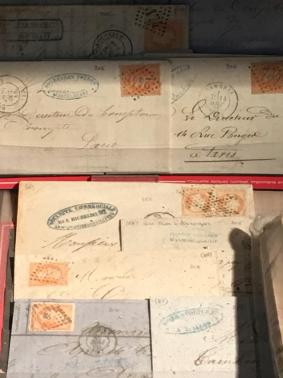
I found these letters at a flea market, the Marche aux Puces de Vanves on the northern Peripherique of Paris. I suppose they come from the estates of people who have died without relatives, or at least without relatives who want to hold onto their old correspondence. They are letters from ordinary people, living ordinary lives that must have been very important to the ones doing the living. They’re all for sale, cheap. I want to know the story of each letter – who wrote it, to whom, how it was received. I want to know what hearts were broken or sustained, what was started or broken off, what bridges were built across the dark air of the world in the days when we had to make an effort to be connected.
On the island of Ikaria in the north Aegean there is a restaurant on the hill above the harbor called MaryMary. It’s owned by a chap called Nikos, who makes the best yiouvetsi in the world, other than his mom. In the months that I lived on Ikaria last year, I used MaryMary as my post office. Letters arrived on a regular basis and I replied to every one of them, but if there’s one thing that’s slower than the South African post office it’s the Greek island postal service, and the two of them together create a kind of perfect storm of slowness, like a barnacle and an oyster having a tug-of-war, so that letters mailed to me a year ago are still arriving at MaryMary, piling up on a shelf in the kitchen. Ikaria is very remote and I won’t make it back there this year, I don’t think. Maybe not next year either – like a drifting Odysseus, I have a lot of islands to visit before then. But I like the thought that one day when I do arrive and walk up the hill from the harbour Nikos will pour me a glass of wine from his barrel and hand me the letters and each of them will be like a visit from a long-lost friend that I never knew I had.
What I hope to do here, each month, maybe sometimes more frequently, is to write you a letter. I don’t know what it will say – give you some news, I guess, or share something I’ve been thinking. I’ll keep it short because I know you’re busy. It means a lot to me – more than I can say – that you want to hear from me, and that you’re someone I can write to. I hope you’ll write back sometimes, but if you’d rather not, that’s perfectly fine. I’m not my grandmother.
Dear friends! Old friends! New friends! Hello! Thank you for visiting my website.
(Perhaps that’s a little overly effusive. I don’t know if that’s how one is supposed to start these things, but I really am very glad you made it here.)
On this website I will be building the archive of my writings, stretching back to 1997. I’ll add new new columns from the past, but I’ll also be writing occasional posts, long and short. And of course, every day I’ll be writing my Daily Delight – see the Daily Delights tab above. They say that the more you look for delight, the more you see it, and I’m hoping to share that with you, because my real reason for creating this website is to build a closer connection between us, to have more of a conversation than is possible in the clamour of social media. I want to share with you, and I hope you’ll share with me.
To stay up to date, subscribe to the newsletter in the box on the right of this page. To read the most recent post, simply scroll down. To read earlier posts, scroll a little further.